
What do you do when people resist (technology) change?
People’s buy-in is essential for technology change. So what do you do when your transformation project is progressing, but not everybody is on board?
The key to managing resistance to change is understanding the underlying cause. But it’s not always what it seems – nor is it always what the people affected tell you it is.
Here are some change management tools which can help diagnose and resolve the causes of resistance, and help everyone get unstuck.
Change is easy when the conditions are right
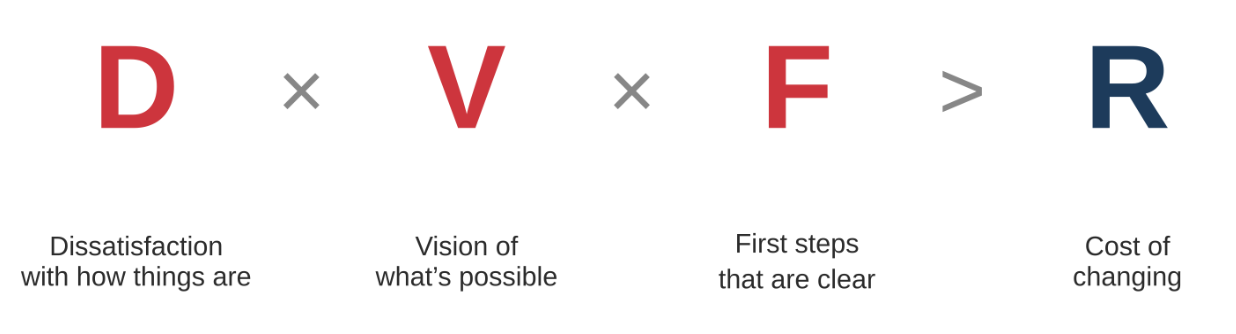
Beckhard-Harris change formula
The Beckhard-Harris change formula is one of the basic change management tools. The formula implies that when any of the factors above (dissatisfaction with how things are, vision of what’s possible, clarity of first steps) are close to zero, the change will get stuck. For example, even if your vision and first steps are clear and strong, when the people involved believe there is no problem to solve (“if it ain’t broke…”), the change will get stuck.
This formula can be really helpful in shaping a positive outcome. I once introduced automation to a team who were building email segments for their event admin emails, writing each one from scratch then manually sending them out. They were already fed up with the way things were done. We calculated that the automation would reduce their work on that task by 60%, so now they were really bought into the proposed solution. Then we worked together on a plan to roll out the new process and system, so they knew what was happening and how.
All this meant the benefit of the change outweighed the cost. The change was much easier than it would have been, had the people impacted felt that change was unnecessary.
Understanding the impact on a team/individual level
In reality, change projects are rarely as straightforward as they are in the example above – even when the benefits are obvious.
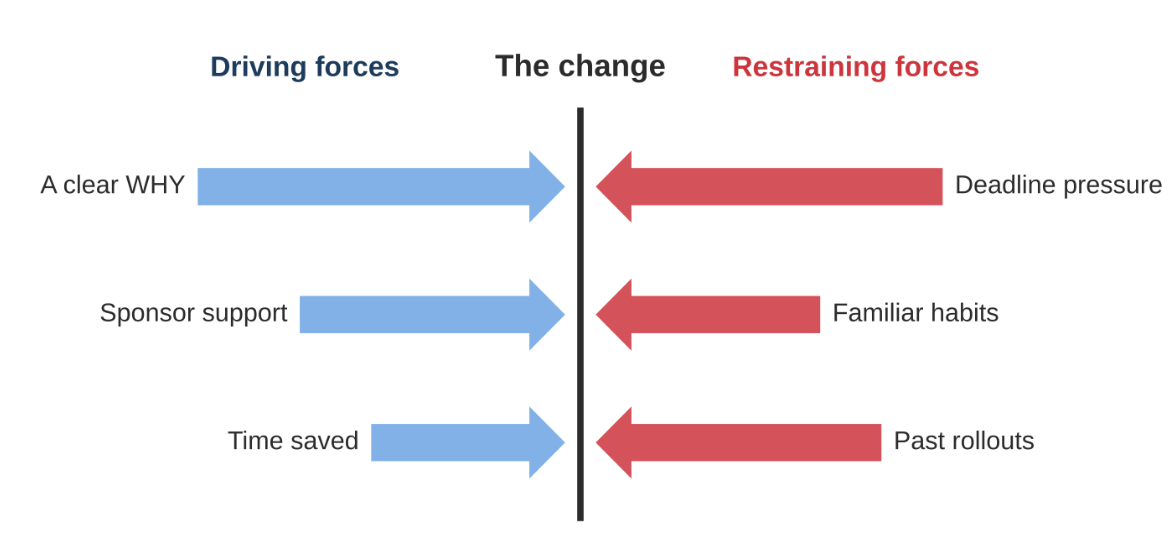
Kurt Lewin’s force field analysis model
Kurt Lewin’s force field analysis model is a helpful way of identifying what may be pushing against the change, even when benefits are clear at a strategic level.
Diagnosing pushback is important – this means identifying the restraining force, what’s behind it and the root causes (these are often about culture, ways of working and behaviours).
To work out what’s really happening, we need to listen. Providing everyone with a way to feed back, and having a process in place to act on that feedback, is vital. It’s equally important to give people enough time to digest and understand why change is happening, and the impact it will have on them – then provide support and guidance to help them through the change.
A long time ago I worked with a senior stakeholder who kept pushing back on all my CRM proposals, putting boundaries and obstacles that undermined the value of change I was suggesting. To me, the change made perfect sense. The new technology offered huge efficiency gains for his team – why would you want to keep the manual process instead of automating?
But what I wasn’t hearing and appreciating is that for the team, the change was massive. It would alter their day-to-day tasks, who did what, and how they planned and worked together. It went much deeper than changing a process. My plan should’ve included a change management timeline and support, not just a technology roadmap.
When the change narrative doesn’t connect
A good change narrative is a key part of any change project. You need to tell people why the change is happening in terms they will actually understand, avoiding business jargon and generic phrases like “responding to market forces” or “supporting our beneficiaries”.
But if your messaging is strong, the data is persuasive, and there’s still resistance – what then?
I once worked with a team who couldn’t see why they needed to change how they did fundraising (i.e. invest in digital fundraising), despite the data showing income declining year on year, with further decline predicted.
When the data doesn't land, it’s time to look at what else might be going on. The SCARF model (Dr David Rock, 2008) is useful for understanding why people are reacting to a change the way they do. Threats to status (e.g. “that used to be my job”), certainty (e.g. “but what does this mean for me in the future?”), autonomy (e.g. “I want to be able to decide”), relatedness (e.g. “I’m losing my people”), and fairness (e.g. “why is this happening to me, but not to others?”) can all result in resistance to change.
As well as gathering and listening carefully to feedback, it’s sometimes helpful to dig beyond initial responses to get to the truth. “Are we sure we need a new CRM, we need to investigate more?” sometimes means “we built a new database in-house in 2000 and it was hell – we don’t want to go through that again.”
Emotional causes of resistance may need a little more patience to identify, but when you can name them, you can then give the team or individual what they need to soften that fear (e.g. a clearer roadmap, acknowledgement of their contributions, co-design opportunities, training, responses to their questions) – and help them feel they own parts of the change.
To help people through change – communicate
The key to all these approaches is good change communication. First, you need to cover what is changing and why. As the project develops you need to explain what will change for whom, what will stay the same, when more information will be available, what support is available, what will be asked of people and when.
The two big takeaways:
Keep repeating what change is happening and why – it takes people different time to digest the message.
Listen for feedback – information vacuums or unanswered questions fester into assumptions or guesses which can undermine trust in the change process and the people leading it.
Double-click to edit...